
Historical Sketch of the ellerbe church
The First Presbyterian Church of Ellerbe, NC, is one of the oldest churches in Richmond County.
Services were first held in 1800 in the home of Mr. Daniel Gillis, which was located about six miles east of the present church location. These services were conducted by the Rev. Murdock McMillan, then a licentiate of Orange Presbytery. The first ruling elders were: Duncan McColl, Duncan Rankin, Daniel Henderson, John McFarland, Sr., and John Billingsly.
The Church was first named Harmony Presbyterian Church. It is interesting to note the reason why this name was given. In the fall of the year 1802, a memorable revival camp meeting was held on Cheek’s Creek. The various congregations within the community participated in the meeting. The people of the various denominations harmonized with the Presbyterians, and as a result of the splendid cooperation, the new Church, when it was organized in 1803, was called Harmony Church. The Church kept this name until 1888. While the Church was under the leadership of the Rev. A. R. Shaw, D.D., the congregation presented a unanimous request to Fayetteville Presbytery, at its spring session, to change its name from Harmony to Ellerbe Springs Presbyterian Church. This request was granted. The Church remained in Fayetteville Presbytery until the year 1917, at which time it was transformed to Mecklenburg Presbytery.
During its history, the Church has erected five buildings. Very soon after the Rev. Murdock McMillan began his ministry in this section, a temporary log meeting house was erected on Mr. John McLoan’s plantation, located about five miles east of the present town of Ellerbe. This log house was used until the first of January, 1803. The site did not prove to be the most central location for the congregation; therefore, a comfortable log church building was erected on a site about one mile east of the present location.
In this building, the Church was organized, and it was used until the year 1831. In that year, a comfortable frame church building was erected on the same location. The building was dedicated to the Glory of God by the Rev. Duncan McIntyre in the same year. This building was used until 1855.
This old site is now being used as the Ellerbe Town Cemetery. On the old tombstones are found the names of some men and women who were prominent in the early life of the Church.
In the year 1855, while the Church was under the leadership of the Rev. Martin McQueen, a very large frame building was erected on the once-famous Ellerbe Springs Camping Ground, situated about one mile north of the present location. The Church was built on the property of Mr. W. P. Ellerbe. This building was used by the congregation from 1855 to 1924. After the erection of our present church building, which was started in 1923, the old church building at Ellerbe Springs was used once a year for homecoming services. However, when the building was declared to be unsafe for services, the congregation ceased to use it, and the property reverted to the family of the original owners.
In the year 1922, while the Church was under the leadership of The Rev. W. C. Rourk, a brick-veneered manse was erected in the town of Ellerbe. This was the first manse owned by the congregation and was built at a cost of forty-five hundred dollars.
Soon after the erection of the manse, in the year 1923, the present sanctuary building was started. Due to financial difficulties, the congregation was not able to complete the building, but year by year, some progress was made toward its completion. In time, it was completed, with a central heating system, new pews and pulpit furniture, now hardwood floors throughout, and the basement was finished.
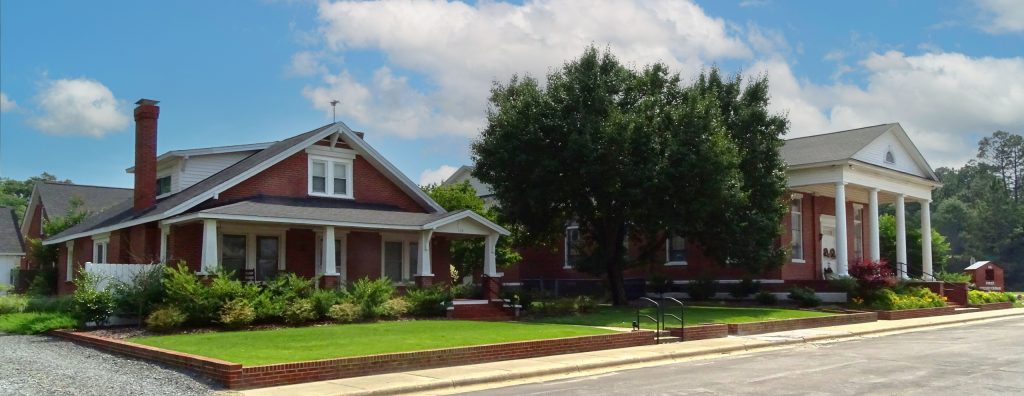
The debt on the building was paid in September of 1944. Up until that time, Presbytery’s Home Mission Committee had given much-needed financial aid to the church in meeting its annual notes. In April of 1947, the Church field, composed of the Ellerbe, Mt. Carmel, and Norman Churches, came to self-support.
In the Spring of 1958, the congregation began using its now educational building, which was built at a cost of a little more than twenty-six thousand dollars. In the summer of the same year, the Church called its first full-time pastor, no longer being grouped with the Mt. Carmel and Norman Churches.
Money borrowed to complete the educational building was fully repaid by the Fall of 1961, and in 1962, the congregation voted to remodel the sanctuary. The vestibule was enlarged, new light fixtures were installed, the organ speakers were relocated, and the walls and ceiling were painted. This work was done at a cost of three thousand dollars.
At the Spring Meeting of Mecklenburg Presbytery, meeting in the First Church of Rockingham, the official name of this Church was declared to be The First Presbyterian Church of Ellerbe, as the congregation had requested.
The present membership of the Church is 164. There are seven Ruling Elders and eight Deacons now serving. In recent years, the Church has grown stronger financially. Its total giving in 1962 amounted to more than eighteen thousand dollars, a third of which went to benevolent causes. Its per capita giving in 1962 was higher than the Assembly’s average, and it ranked fifth in per capita giving to benevolent causes among the one hundred and twenty-five churches of its size throughout the General Assembly.
The present congregation is grateful to God for those who have gone before them, giving themselves, their time, and their means to “keep the Church going” through the years, under God.
We recognize and appreciate Marjorie Parsons, a dedicated member of First Presbyterian Church, for her diligent research, composition, and publication of the “Historical Sketch of the Ellerbe Church” in April 1963. Her work preserved vital details spanning from 1800 to 1963, helping document our church’s rich 225-year history. We are grateful for her dedication and vision in capturing this important legacy.
[Top Image – Drawing of 1847 Church Building, Ellerbe Springs]
Additional History by J. Neal Cadieu
According to Miss Rebecca Howell in her work “Sketch of The History of Harmony Church,” the First Presbyterian Church of Ellerbe dates its beginnings to a meeting in 1800 when Murdock McMilliam of the Orange Presbytery preached a sermon at the home of Daniel Gillis. Later, a temporary log meeting house was built on the property of John McLean.
Two years later, a building was constructed where the present Town of Ellerbe cemetery is located.
About 1857, a new church was built at Ellerbe Springs and occupied by the Harmony Church membership. It retained the name of Harmony until April 11-14, 1888, when “By unanimous request of the congregation, the Presbytery at its session held at Jonesboro in Moore County…changed the name of Harmony Church to that of Ellerbe Springs Church,” according to church minutes.
“Residents of the Ellerbe area who remember the old Ellerbe Springs Church building state that this was one of the most beautiful when it was built. It is reported that the building bore the scars of a Civil War skirmish when it was replaced in 1924 by the modern First Presbyterian Church in the town of Ellerbe,” stated Miss Howell in Huneycutt’s A History of Richmond County.
Several Ellerbe residents still living record that David A. Boyd was the builder of the Ellerbe Springs church, as does McSwain in My Folk.
Writing for the Sept. 27, 1934, issue of the Rockingham Post-Dispatch, Rev. W. G. Thomas, pastor of the Ellerbe First Presbyterian Church states that “under the leadership of Rev. Martin McQueen, a very large frame building was erected at Ellerbe Springs on the property of W. Т. Ellerbe. In the year 1922, while the church was under the leadership of W. C. Rourk, a beautiful brick manse was erected. Soon after, in the year 1923, the present church was started. On account of financial difficulties, the congregation was not able to complete the building, but year by year some new headway is made.” (Note: Apparently, the church was not complete when this 1934 article appeared.)
“The old church at Ellerbe Springs was used once a year for a home coming service. (Eventually) on account of the dilapidated condition of the old building it became too dangerous for use as a place of worship. With its building debt, the congregation was not able to repair the old building and after it was abandoned the property reverted to the owners of the land. Although the old church building is gone, the beautiful grove of trees and the historic location will continue to bring up memories that will never grow dim.”
A later writer, Mrs. Eleanor Pratt Covington McSwain, stated in her book, My Folks, that the Ellerbe Springs Presbyterian Church stood in what is now a rest area for highway travelers. She gives credit to the church being moved to Ellerbe Springs to the Rev. John McFarland.
Pieces of the Ellerbe Springs Presbyterian Church still survive in attics and barns in and around Ellerbe, some of those pieces said to contain bullet holes made during the Civil War.
This writer has heard three tales concerning the bullet holes. The most prevailing story is that a skirmish between Union and Confederate soldiers took place near the church. Another is that Union soldiers passing through shot at the church to let people know they had passed. The third is that a number of slaves sought safety in the church and were frightened out of the church by shots fired from the outside. It is doubtful that the truth is known and it may well be the bullet holes are the results of vandalism.
Grady Meacham in an interview with John Patrick Hutchinson on Jan. 22, 1991, said: “One of the oldest Presbyterian churches anywhere nearby was right out there on the hill (above Ellerbe Springs) where the park is. Since then it’s been taken down. And they had a place in the back where slaves could worship up in the back end of it there. They’d come in the back, you know–(sit) in a balcony. The church had bullet holes in the side of it from a battle (Civil War skirmish) that took place out there.”
We gratefully acknowledge J. Neal Cadieu, author of The History of Ellerbe Springs from 1820 to 1995, for granting permission to reference his work. His article (“Ellerbe Springs Presbyterian Church,” page 8) provides valuable historical insights into the church, documenting key events from the 1800s and 1900s that enrich our understanding and gratitude of the church’s early years. We appreciate his contribution in preserving this important history.
[Collage Image – Groundbreaking of the new Fellowship Hall in 2006]
[Top Banner Image – Pre-Civil War Communion Set]